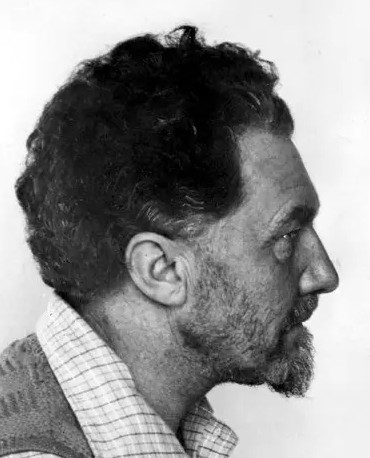
POUND, Ezra
Alba
As cool as the pale wet leaves
of lily-of-the-valley
She lay beside me in the dawn.
And the days are not full enough
And the days are not full enough
And the nights are not full enough
And life slips by like a field mouse
Not shaking the grass
The Rest
O helpless few in my country, remnant enslaved!
Artists broken against her,
A-stray, lost in the villages,
Mistrusted, spoken-against,
Lovers of beauty, starved,
Thwarted with systems,
Helpless against the control;
You who cannot wear yourselves out
By persisting to successes,
You who can only speak,
Who cannot steel yourselves into reiteration;
You of the finer sense,
Broken against false knowledge,
You who can know at first hand,
Hated, shut in, mistrusted:
Take thought:
I have weathered the storm,
I have beaten out my exile.
Salutation
O generation of the thoroughly smug
and thoroughly uncomfortable,
I have seen fishermen picnicking in the sun,
I have seen them with untidy families,
I have seen their smiles full of teeth
and heard ungainly laughter.
And I am happier than you are,
And they were happier than I am;
And the fish swim in the lake
and do not even own clothing.
To-Em-Mei’s «The Unmoving Cloud»
“Wet spring time,' says To-em-mei, 'Wet spring in the garden.”
I
The clouds have gathered and gathered,
and the rain falls and falls,
The eight ply of the heavens
are all folded into one darkness,
And the wide flat road stretches out.
I stop in my room towards the East, quiet, quiet,
I pat my new cask of wine.
My friends are estranged, or far distant,
I bow my head and stand still.
II
Rain, rain, and the clouds have gathered,
The eight ply of the heavens are darkness,
The flat land is turned into river.
“Wine, wine, wine, here is wine!”
I drink by my eastern window.
I think of talking and man,
And no boat, no carriage approaches.
III
The trees in my east-looking garden
are bursting out with new twigs,
They try to stir new affection,
And men say the sun and moon keep on moving
because they can’t find a soft seat.
The birds flutter to rest in my tree
and I think I have heard them saying,
It is not that there are no other men
But we like this fellow the best,
But however we long to speak
He cannot know of our sorrow.
Sestina: Altaforte
(…)
Damn it all! all this our South stinks peace.
You whoreson dog, Papiols, come! Let's to music!
I have no life save when the swords clash.
But ah! when I see the standards gold, vair, purple, opposing
And the broad fields beneath them turn crimson,
Then howl I my heart nigh mad with rejoicing.
II
In hot summer have I great rejoicing
When the tempests kill the earth's foul peace,
And the lightnings from black heav'n flash crimson,
And the fierce thunders roar me their music
And the winds shriek through the clouds mad, opposing,
And through all the riven skies God's swords clash.
III
Hell grant soon we hear again the swords clash!
And the shrill neighs of destriers in battle rejoicing,
Spiked breast to spiked breast opposing!
Better one hour's stour than a year's peace
With fat boards, bawds, wine and frail music!
Bah! there's no wine like the blood's crimson!
IV
And I love to see the sun rise blood-crimson.
And I watch his spears through the dark clash
And it fills all my heart with rejoicing
And pries wide my mouth with fast music
When I see him so scorn and defy peace,
His lone might 'gainst all darkness opposing.
V
The man who fears war and squats opposing
My words for stour, hath no blood of crimson
But is fit only to rot in womanish peace
Far from where worth's won and the swords clash
For the death of such sluts I go rejoicing;
Yea, I fill all the air with my music.
VI
Papiols, Papiols, to the music!
There's no sound like to swords swords opposing,
No cry like the battle's rejoicing
When our elbows and swords drip the crimson
And our charges 'gainst "The Leopard's" rush clash.
May God damn for ever all who cry "Peace!"
VII
And let the music of the swords make them crimson!
Hell grant soon we hear again the swords clash!
Hell blot black for always the thought "Peace!"
Portrait d'une Femme
Your mind and you are our Sargasso Sea,
London has swept about you this score years
And bright ships left you this or that in fee:
Ideas, old gossip, oddments of all things,
Strange spars of knowledge and dimmed wares of price.
Great minds have sought you — lacking someone else.
You have been second always. Tragical?
No. You preferred it to the usual thing:
One dull man, dulling and uxorious,
One average mind — with one thought less, each year.
Oh, you are patient, I have seen you sit
Hours, where something might have floated up.
And now you pay one. Yes, you richly pay.
You are a person of some interest, one comes to you
And takes strange gain away:
Trophies fished up; some curious suggestion;
Fact that leads nowhere; and a tale for two,
Pregnant with mandrakes, or with something else
That might prove useful and yet never proves,
That never fits a corner or shows use,
Or finds its hour upon the loom of days:
The tarnished, gaudy, wonderful old work;
Idols and ambergris and rare inlays,
These are your riches, your great store; and yet
For all this sea-hoard of deciduous things,
Strange woods half sodden, and new brighter stuff:
In the slow float of differing light and deep,
No! there is nothing! In the whole and all,
Nothing that's quite your own.
Yet this is you .
/////////////////////////////////////////////////
And New York is the most beautiful city in the world?
It is not far from it.
No urban night is like the night there.
Squares after squares of flame,
set up and cut into the aether.
Here is our poetry,
for we have pulled down the stars to our will
/////////////////////////////////////////////////
Francesca
You came in out of the night
And there were flowers in your hands,
Now you will come out of a confusion of people,
Out of a turmoil of speech about you.
I who have seen you amid the primal things
Was angry when they spoke your name
In ordinary places.
I would that the cool waves might flow over my mind,
And that the world should dry as a dead leaf,
Or as a dandelion seed-pod and be swept away,
So that I might find you again,
Alone.
The Return
See, they return; ah, see the tentative
Movements, and the slow feet,
The trouble in the pace and the uncertain
Wavering!
See, they return, one, and by one,
With fear, as half-awakened;
As if the snow should hesitate
And murmur in the wind,
and half turn back;
These were the "Wing'd-with-Awe,"
inviolable.
Gods of the wingèd shoe!
With them the silver hounds,
sniffing the trace of air!
Haie! Haie!
These were the swift to harry;
These the keen-scented;
These were the souls of blood.
Slow on the leash,
pallid the leash-men!
Pisan Cantos
…..
The ant’s a centaur in his dragon world.
Pull down thy vanity, it is not man
Made courage, or made order, or made grace,
Pull down thy vanity, I say pull down.
Learn of the green world what can be thy place
In scaled invention or true artistry,
Pull down thy vanity,
Paquin pull down!
The green casque has outdone your elegance.
…..
The Garden
En robe de parade. Samain *
Like a skein of loose silk blown against a wall
She walks by the railing of a path in Kensington Gardens,
And she is dying piece-meal
of a sort of emotional anaemia.
And round about there is a rabble
Of the filthy, sturdy, unkillable infants of the very poor.
They shall inherit the earth.
In her is the end of breeding.
Her boredom is exquisite and excessive.
She would like some one to speak to her,
And is almost afraid that I
will commit that indiscretion.
¨*Albert Samain = French poet
La Regina Avrillouse
Lady of rich allure,
Queen of the spring's embrace,
Your arms are long like boughs of ash,
Mid laugh-broken streams, spirit of rain unsure,
Breath of the poppy flower,
All the wood thy bower
And the hills thy dwelling-place.
This will I no more dream;
Warm is thy arm's allure,
Warm is the gust of breath
That ere thy lips meet mine
Kisseth my cheek and saith:
"This is the joy of earth,
Here is the wine of mirth
Drain ye one goblet sure,
Take ye the honey cup
The honied song raise up,
Drink of the spring's allure,
April and dew and rain;
Brown of the earth sing sure,
Cheeks and lips and hair
And soft breath that kisseth where
Thy lips have come not yet to drink."
Moss and the mold of earth,
These be thy couch of mirth,
Long arms thy boughs of shade
April-alluring, as the blade
Of grass doth catch the dew
And make it crown to hold the sun.
Banner be you
Above my head,
Glory to all wold display'd,
April-alluring, glory-bold.
The Temperaments
Nine adulteries, 12 liaisons, 64 fornications and something approaching a rape
Rest nightly upon the soul of our delicate friend Florialis,
And yet the man is so quiet and reserved in demeanour
That he passes for both bloodless and sexless.
Bastidides, on the contrary, who both talks and writes of nothing save copulation,
Has become the father of twins,
But he accomplished this feat at some cost;
He had to be four times cuckold.
Masks
These tales of old disguisings, are they not
Strange myths of souls that found themselves among
Unwonted folk that spake an hostile tongue,
Some soul from all the rest who'd not forgot
The star-span acres of a former lot
Where boundless mid the clouds his course he swung,
Or carnate with his elder brothers sung
Ere ballad-makers lisped of Camelot?
Old singers half-forgetful of their tunes,
Old painters color-blind come back once more,
Old poets skill-less in the wind-heart runes,
Old wizards lacking in their wonder-lore:
All they that with strange sadness in their eyes
Ponder in silence o'er earth's queynt devyse?
Ballatetta
The light became her grace and dwelt among
Blind eyes and shadows that are formed as men;
Lo, how the light doth melt us into song:
The broken sunlight for a healm she beareth
Who has my heart in jurisdiction.
In wild-wood never fawn nor allow fareth
So silent light; no gossamer is spun
So delicate as she is, when the sun
Drives the clear emeralds from the bended grasses
Lest they should parch too swiftly, where she passes
The Garrett
Come, let us pity those who are better off than we are.
Come, my friend, and remember
that the rich have butlers and no friends,
And we have friends and no butlers.
Come, let us pity the married and the unmarried.
Dawn enters with little feet
like a gilded Pavlova
And I am near my desire.
Nor has life in it aught* better
Than this hour of clear coolness
the hour of waking together.
* anything
Hugh Selwyn Mauberly
…..
IV
These fought in any case,
and some believing,
pro domo, in any case . . .
Some quick to arm,
some for adventure,
some from fear of weakness,
some from fear of censure,
some for love of slaughter, in imagination,
learning later . . .
some in fear, learning love of slaughter;
Died some, pro patria,
non "dulce" non "et decor" . . .
walked eye-deep in hell
believing in old men's lies, then unbelieving
came home, home to a lie,
home to many deceits,
home to old lies and new infamy;
usury age-old and age-thick
and liars in public places.
Daring as never before, wastage as never before.
Young blood and high blood,
fair cheeks, and fine bodies;
fortitude as never before
frankness as never before,
disillusions as never told in the old days,
hysterias, trench confessions,
laughter out of dead bellies.
V
There died a myriad,
And of the best, among them,
For an old bitch gone in the teeth,
For a botched civilization,
Charm, smiling at the good mouth,
Quick eyes gone under earth's lid,
For two gross of broken statues,
For a few thousand battered books.
…..
Canto XLV
With Usura
With usura hath no man a house of good stone
each block cut smooth and well fitting
that design might cover their face,
with usura
hath no man a painted paradise on his church wall
harpes et luz
or where virgin receiveth message
and halo projects from incision,
with usura
seeth no man Gonzaga his heirs and his concubines
no picture is made to endure nor to live with
but it is made to sell and sell quickly
with usura, sin against nature,
is thy bread ever more of stale rags
is thy bread dry as paper,
with no mountain wheat, no strong flour
with usura the line grows thick
with usura is no clear demarcation
and no man can find site for his dwelling.
Stonecutter is kept from his stone
weaver is kept from his loom
WITH USURA
wool comes not to market
sheep bringeth no gain with usura
Usura is a murrain, usura
blunteth the needle in the maid’s hand
and stoppeth the spinner’s cunning. Pietro Lombardo
came not by usura
Duccio came not by usura
nor Pier della Francesca; Zuan Bellin’ not by usura
nor was ‘La Calunnia’ painted.
Came not by usura Angelico; came not Ambrogio Praedis,
Came no church of cut stone signed: Adamo me fecit.
Not by usura St. Trophime
Not by usura Saint Hilaire,
Usura rusteth the chisel
It rusteth the craft and the craftsman
It gnaweth the thread in the loom
None learneth to weave gold in her pattern;
Azure hath a canker by usura; cramoisi is unbroidered
Emerald findeth no Memling
Usura slayeth the child in the womb
It stayeth the young man’s courting
It hath brought palsey to bed, lyeth
between the young bride and her bridegroom
CONTRA NATURAM
They have brought whores for Eleusis
Corpses are set to banquet
at behest of usura.
Ballad of the Goodly Fere
Simon Zelotes speaking after the Crucifixion. Fere=Mate, Companion.
Ha' we lost the goodliest fere o' all
For the priests and the gallows tree?
Aye lover he was of brawny men,
O' ships and the open sea.
When they came wi' a host to take Our Man
His smile was good to see,
"First let these go!" quo' our Goodly Fere,
"Or I'll see ye damned," says he.
Aye he sent us out through the crossed high spears
And the scorn of his laugh rang free,
"Why took ye not me when I walked about
Alone in the town?" says he.
Oh we drank his "Hale" in the good red wine
When we last made company,
No capon priest was the Goodly Fere
But a man o' men was he.
I ha' seen him drive a hundred men
Wi' a bundle o' cords swung free,
That they took the high and holy house
For their pawn and treasury.
They'll no' get him a' in a book I think
Though they write it cunningly;
No mouse of the scrolls was the Goodly Fere
But aye loved the open sea.
If they think they ha' snared our Goodly Fere
They are fools to the last degree.
"I'll go to the feast," quo' our Goodly Fere,
"Though I go to the gallows tree."
"Ye ha' seen me heal the lame and blind,
And wake the dead," says he,
"Ye shall see one thing to master all:
'Tis how a brave man dies on the tree."
A son of God was the Goodly Fere
That bade us his brothers be.
I ha' seen him cow a thousand men.
I have seen him upon the tree.
He cried no cry when they drave the nails
And the blood gushed hot and free,
The hounds of the crimson sky gave tongue
But never a cry cried he.
I ha' seen him cow a thousand men
On the hills o' Galilee,
They whined as he walked out calm between,
Wi' his eyes like the grey o' the sea,
Like the sea that brooks no voyaging
With the winds unleashed and free,
Like the sea that he cowed at Genseret
Wi' twey words spoke' suddently.
A master of men was the Goodly Fere,
A mate of the wind and sea,
If they think they ha' slain our Goodly Fere
They are fools eternally.
I ha' seen him eat o' the honey-comb
Sin' they nailed him to the tree.
Lament Of The Frontier Guard
By the North Gate, the wind blows full of sand,
Lonely from the beginning of time until now!
Trees fall, the grass goes yellow with autumn.
I climb the towers and towers
to watch out the barbarous land:
Desolate castle, the sky, the wide desert.
There is no wall left to this village.
Bones white with a thousand frosts,
High heaps, covered with trees and grass;
Who brought this to pass?
Who has brought the flaming imperial anger?
Who has brought the army with drums and with kettle-drums?
Barbarous kings.
A gracious spring, turned to blood-ravenous autumn,
A turmoil of wars - men, spread over the middle kingdom,
Three hundred and sixty thousand,
And sorrow, sorrow like rain.
Sorrow to go, and sorrow, sorrow returning,
Desolate, desolate fields,
And no children of warfare upon them,
No longer the men for offence and defence.
Ah, how shall you know the dreary sorrow at the North Gate,
With Rihoku's name forgotten,
And we guardsmen fed to the tigers.
[Li Po?]
Canto I
And then went down to the ship,
Set keel to breakers, forth on the godly sea, and
We set up mast and sail on that swart ship,
Bore sheep aboard her, and our bodies also
Heavy with weeping, and winds from sternward
Bore us out onward with bellying canvas,
Circe’s this craft, the trim-coifed goddess.
Then sat we amidships, wind jamming the tiller,
Thus with stretched sail, we went over sea till day’s end.
Sun to his slumber, shadows o’er all the ocean,
Came we then to the bounds of deepest water,
To the Kimmerian lands, and peopled cities
Covered with close-webbed mist, unpierced ever
With glitter of sun-rays
Nor with stars stretched, nor looking back from heaven
Swartest night stretched over wretched men there.
The ocean flowing backward, came we then to the place
Aforesaid by Circe.
Here did they rites, Perimedes and Eurylochus,
And drawing sword from my hip
I dug the ell-square pitkin;
Poured we libations unto each the dead,
First mead and then sweet wine, water mixed with white flour.
Then prayed I many a prayer to the sickly death’s-heads;
As set in Ithaca, sterile bulls of the best
For sacrifice, heaping the pyre with goods,
A sheep to Tiresias only, black and a bell-sheep.
Dark blood flowed in the fosse,
Souls out of Erebus, cadaverous dead, of brides
Of youths and of the old who had borne much;
Souls stained with recent tears, girls tender,
Men many, mauled with bronze lance heads,
Battle spoil, bearing yet dreory arms,
These many crowded about me; with shouting,
Pallor upon me, cried to my men for more beasts;
Slaughtered the herds, sheep slain of bronze;
Poured ointment, cried to the gods,
To Pluto the strong, and praised Proserpine;
Unsheathed the narrow sword,
I sat to keep off the impetuous impotent dead,
Till I should hear Tiresias.
But first Elpenor came, our friend Elpenor,
Unburied, cast on the wide earth,
Limbs that we left in the house of Circe,
Unwept, unwrapped in sepulchre, since toils urged other.
Pitiful spirit. And I cried in hurried speech:
“Elpenor, how art thou come to this dark coast?
“Cam’st thou afoot, outstripping seamen?”
And he in heavy speech:
“Ill fate and abundant wine. I slept in Circe’s ingle.
“Going down the long ladder unguarded,
“I fell against the buttress,
“Shattered the nape-nerve, the soul sought Avernus.
“But thou, O King, I bid remember me, unwept, unburied,
“Heap up mine arms, be tomb by sea-bord, and inscribed:
“A man of no fortune, and with a name to come.
“And set my oar up, that I swung mid fellows.”
And Anticlea came, whom I beat off, and then Tiresias Theban,
Holding his golden wand, knew me, and spoke first:
“A second time? why? man of ill star,
“Facing the sunless dead and this joyless region?
“Stand from the fosse, leave me my bloody bever
“For soothsay.”
And I stepped back,
And he strong with the blood, said then: “Odysseus
“Shalt return through spiteful Neptune, over dark seas,
“Lose all companions.” And then Anticlea came.
Lie quiet Divus. I mean, that is Andreas Divus,
In officina Wecheli, 1538, out of Homer.
And he sailed, by Sirens and thence outward and away
And unto Circe.
…..
The River-Merchant’s Wife: A Letter
After Li Po
While my hair was still cut straight across my forehead
I played about the front gate, pulling flowers.
You came by on bamboo stilts, playing horse,
You walked about my seat, playing with blue plums.
And we went on living in the village of Chōkan:
Two small people, without dislike or suspicion.
At fourteen I married My Lord you.
I never laughed, being bashful.
Lowering my head, I looked at the wall.
Called to, a thousand times, I never looked back.
At fifteen I stopped scowling,
I desired my dust to be mingled with yours
Forever and forever, and forever.
Why should I climb the look out?
At sixteen you departed
You went into far Ku-tō-en, by the river of swirling eddies,
And you have been gone five months.
The monkeys make sorrowful noise overhead.
You dragged your feet when you went out.
By the gate now, the moss is grown, the different mosses,
Too deep to clear them away!
The leaves fall early this autumn, in wind.
The paired butterflies are already yellow with August
Over the grass in the West garden;
They hurt me.
I grow older.
If you are coming down through the narrows of the river Kiang,
Please let me know beforehand,
And I will come out to meet you
As far as Chō-fū-Sa.
Dance figure
For the Marriage in Cana of Galilee
Dark eyed,
O woman of my dreams,
Ivory sandalled,
There is none like thee among the dancers,
None with swift feet.
I have not found thee in the tents,
In the broken darkness.
I have not found thee at the well-head
Among the women with pitchers.
Thine arms are as young sapling under the bark;
Thy face is a river with lights.
White as an almond are thy shoulders;
As new almonds stripped from the husk.
They guard thee not with enunchs;
Not with bars of copper.
Gilt turquoise and silver are in the pIace of thy resto
A brown robe, with threads of gold woven in patterns, hast thou
gathered about thee,
O Nathat-Ikanaie, "Tree at the river".
As a rillet among the sedge are thy hands upon me;
Thy fingers a frosted stream.
Thy maidens are white like pebbles;
Their music about thee!
There is none like thee among the dancers;
None with swift feet.
What Thou Lovest Well Remains
…..
What thou lovest well remains,
the rest is dross
What thou lov'st well shall not be reft from thee
What thou lov'st well is thy true heritage
Whose world, or mine or theirs
or is it of none?
First came the seen, then thus the palpable
Elysium, though it were in the halls of hell,
What thou lov'st well is thy true heritage
What thou lov'st well shall not be reft from thee
The ant's a centaur in his dragon world.
Pull down thy vanity, it is not man
Made courage, or made order, or made grace,
Pull down thy vanity, I say pull down.
Learn of the green world what can be thy place
In scaled invention or true artistry,
Pull down thy vanity ,
Paquin pull down!
The green casque has outdone your elegance.
'Master thyself, then others shall thee beare'
Pull down thy vanity
"Master thyself, then others shall thee beare"
Pull down thy vanity
Thou art a beaten dog beneath the hail,
A swollen magpie in a fitful sun,
Half black half white
Nor knowst'ou wing from tail
Pull down thy vanity
How mean thy hates
Fostered in falsity,
Pull down thy vanity,
Rathe to destroy, niggard in charity,
Pull down thy vanity,
I say pull down.
But to have done instead of not doing
This is not vanity
To have, with decency, knocked
That a Blunt should open
To have gathered from the air a live tradition
or from a fine old eye the unconquered flame
this is not vanity.
Here error is all in the not done,
all in the diffidence that faltered . . .
…..
Commission
GO, my songs, to the lonely and the unsatisfied,
Go also to the nerve-wracked, go to the enslaved-by-convention,
Bear to them my contempt for their oppressors.
Go as a great wave of cool water,
Bear my contempt of oppressors.
Speak against unconscious oppression,
Speak against the tyranny of the unimaginative,
Speak against bonds.
Go to the bourgeoise who is dying of her ennuis,
Go to the women in suburbs.
Go to the hideously wedded,
Go to them whose failure is concealed,
Go to the unluckily mated,
Go to the bought wife,
Go to the woman entailed.
Go to those who have delicate lust,
Go to those whose delicate desires are thwarted,
Go like a blight upon the dulness of the world;
Go with your edge against this,
Strengthen the subtle cords,
Bring confidence upon the algae and the tentacles of the soul.
Go in a friendly manner,
Go with an open speech.
Be eager to find new evils and new good,
Be against all forms of oppression.
Go to those who are thickened with middle age,
To those who have lost their interest.
Go to the adolescent who are smothered in family—
Oh how hideous it is
To see three generations of one house gathered together!
It is like an old tree with shoots,
And with some branches rotted and falling.
Go out and defy opinion,
Go against this vegetable bondage of the blood.
Speak for the free kinship of the mind and spirit
Go, against all forms of oppression.