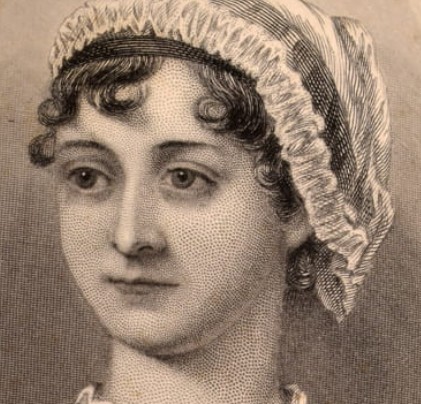
AUSTEN, Jane
Mansfield Park
…..
To the education of her daughters Lady Bertram paid not the smallest attention. She had not time for such cares. She was a woman who spent her days in sitting, nicely dressed, on a sofa, doing some long piece of needlework, of little use and no beauty, thinking more of her pug than her children, but very indulgent to the latter when it did not put herself to inconvenience, guided in everything important by Sir Thomas, and in smaller concerns by her sister. Had she possessed greater leisure for the service of her girls, she would probably have supposed it unnecessary, for they were under the care of a governess, with proper masters, and could want nothing more. As for Fanny's being stupid at learning, "she could only say it was very unlucky, but some people were stupid, and Fanny must take more pains: she did not know what else was to be done; and, except her being so dull, she must add she saw no harm in the poor little thing, and always found her very handy and quick in carrying messages, and fetching what she wanted."
…..
Sense and Sensibility
…..
The woods and walks thickly covered with dead leaves.” “Oh!” cried Marianne, “with what transporting sensation have I formerly seen them fall! How have I delighted, as I walked, to see them driven in showers about me by the wind! What feelings have they, the season, the air altogether inspired! Now there is no one to regard them. They are seen only as a nuisance, swept hastily off, and driven as much as possible from the sight.” “It is not every one,” said Elinor, “who has your passion for dead leaves.” “No; my feelings are not often shared, not often understood.
…..
Mrs. John Dashwood did not at all approve of what her husband intended to do for his sisters. To take three thousand pounds from the fortune of their dear little boy would be impoverishing him to the most dreadful degree. She begged him to think again on the subject. How could he answer it to himself to rob his child, and his only child too, of so large a sum? And what possible claim could the Misses Dashwood, who were related to him only by half blood, which she considered as no relationship at all, have on his generosity to so large an amount? It was very well known that no affection was ever supposed to exist between the children of any man by different marriages; and why was he to ruin him
…..
Emma
…..
Never had the exquisite sight, smell, sensation of nature, tranquil, warm, and brilliant after a storm, been more attractive to her. She longed for the serenity they might gradually introduce, and ... she lost no time ill hurrying into the shrubbery. -- There, with spirits freshened and thoughts a little relieved, she had taken a few turns, when she saw Mr. Knightley passing through the garden door and coming towards her. -- It was the first intimation of his being returned from London. She had been thinking of him the moment before as unquestionably sixteen miles distant. -- There was time only for the quickest arrangement of mind. She must be collected and calm. In half a minute they were together. The "How d'ye do's" were quiet and constrained on each side. She asked after their mutual friends; they were all well... He meant to walk with her, she found. "He had just looked into the dining-room, and as he was not wanted there, preferred being out of doors." -- She thought he neither looked nor spoke cheerfully; and the first possible cause for it, suggested by her fears, was, that he had perhaps been communicating his plans to his brother, and was pained by the manner in which they had been received.
They walked together. He was silent. She thought he was often looking at her, and trying for a fuller view of her face than it suited her to give. And this belief produced another dread. Perhaps he wanted to speak to her, of his attachment to Harriet; he might be watching for encouragement to begin. -- She did not, could not, feel equal to lead the way to any such subject. He must do it all himself. Yet she could not bear this silence. With him it was most unnatural. She considered -- resolved -- and, trying to smile, began --
"You have some news to hear, now you are come back, that will rather surprize you."
"Have I?" said he quietly, and looking at her; "of what nature?"
"Oh! the best nature in the world -- a wedding."
After waiting a moment, as if to be sure she intended to say no more, he replied, "If you mean Miss Fairfax and Frank Churchill, I have heard that already."
"How is it possible?" cried Emma, turning her glowing cheeks towards him; for, while she spoke, it occurred to her that he might have called [on Harriet Smith] in his way.
"I had a few lines on parish business from Mr. Weston this morning, and at the end of them he gave me a brief account of what had happened."
Emma was quite relieved, and could presently say, with a little more composure, "You probably have been less surprized than any of us, for you have had your suspicions. -- I have not forgotten that you once tried to give me a caution. -- I wish I had attended to it -- but --" (with a sinking voice and a heavy sigh) "I seem to have been doomed to blindness."
For a moment or two nothing was said, and she was unsuspicious of having excited any particular interest, till she found her arm drawn within his, and pressed against his heart, and heard him thus saying, in a tone of great sensibility, speaking low, "Time, my dearest Emma, time will heal the wound. -- Your own excellent sense -- your exertions for your father's sake -- I know you will not allow yourself. --" Her arm was pressed again, as he added, in a more broken and subdued accent, "The feelings of the warmest friendship -- Indignation -- Abominable scoundrel!" -- And in a louder, steadier tone, he concluded with, "He will soon be gone. They will soon be in Yorkshire. I am sorry for her. She deserves a better fate."
Emma understood him; and as soon as she could recover from the flutter of pleasure excited by such tender consideration, replied, "You are very kind -- but you are mistaken -- and I must set you right. -- I am not in want of that sort of compassion."
…..
Pride and Prejudice
Chapter 8
…..
At five o'clock the two ladies retired to dress, and at half-past six Elizabeth was summoned to dinner. To the civil enquiries which then poured in, and amongst which she had the pleasure of distinguishing the much superior solicitude of Mr. Bingley's, she could not make a very favourable answer. Jane was by no means better. The sisters, on hearing this, repeated three or four times how much they were grieved, how shocking it was to have a bad cold, and how excessively they disliked being ill themselves; and then thought no more of the matter; and their indifference towards Jane when not immediately before them, restored Elizabeth to the enjoyment of all her original dislike.
Their brother, indeed, was the only one of the party whom she could regard with any complacency. His anxiety for Jane was evident, and his attentions to herself most pleasing, and they prevented her feeling herself so much an intruder as she believed she was considered by the others. She had very little notice from any but him. Miss Bingley was engrossed by Mr. Darcy, her sister scarcely less so; and as for Mr. Hurst, by whom Elizabeth sat, he was an indolent man, who lived only to eat, drink, and play at cards; who, when he found her prefer a plain dish to a ragout, had nothing to say to her.
When dinner was over she returned directly to Jane, and Miss Bingley began abusing her as soon as she was out of the room. Her manners were pronounced to be very bad indeed, a mixture of pride and impertinence; she had no conversation, no style, no taste, no beauty. Mrs. Hurst thought the same, and added --
"She has nothing, in short, to recommend her, but being an excellent walker. I shall never forget her appearance this morning. She really looked almost wild."
"She did indeed, Louisa. I could hardly keep my countenance. Very nonsensical to come at all! Why must she be scampering about the country, because her sister had a cold? Her hair, so untidy, so blowsy!"
"Yes, and her petticoat; I hope you saw her petticoat, six inches deep in mud, I am absolutely certain; and the gown which had been let down to hide it, not doing its office."
"Your picture may be very exact, Louisa," said Bingley; "but this was all lost upon me. I thought Miss Elizabeth Bennet looked remarkably well when she came into the room this morning. Her dirty petticoat quite escaped my notice."
" You observed it, Mr. Darcy, I am sure," said Miss Bingley; "and I am inclined to think that you would not wish to see your sister make such an exhibition."
"Certainly not."
"To walk three miles, or four miles, or five miles, or whatever it is, above her ancles in dirt, and alone, quite alone! what could she mean by it? It seems to me to shew an abominable sort of conceited independence, a most country-town indifference to decorum."
"It shows an affection for her sister that is very pleasing," said Bingley.
"I am afraid, Mr. Darcy," observed Miss Bingley, in a half-whisper, "that this adventure has rather affected your admiration of her fine eyes."
"Not at all," he replied; "they were brightened by the exercise." A short pause followed this speech, and Mrs. Hurst began again --
"I have an excessive regard for Jane Bennet; she is really a very sweet girl, and I wish with all my heart she were well settled. But with such a father and mother, and such low connections, I am afraid there is no chance of it."
"I think I have heard you say that their uncle is an attorney in Meryton."
"Yes; and they have another, who lives somewhere near Cheapside."
"That is capital," added her sister, and they both laughed heartily.
"If they had uncles enough to fill all Cheapside," cried Bingley, "it would not make them one jot less agreeable."
"But it must very materially lessen their chance of marrying men of any consideration in the world," replied Darcy.
To this speech Bingley made no answer; but his sisters gave it their hearty assent, and indulged their mirth for some time at the expense of their dear friend's vulgar relations.
With a renewal of tenderness, however, they repaired to her room on leaving the dining-parlour, and sat with her till summoned to coffee. She was still very poorly, and Elizabeth would not quit her at all, till late in the evening, when she had the comfort of seeing her asleep, and when it appeared to her rather right than pleasant that she should go down stairs herself. On entering the drawing-room she found the whole party at loo, and was immediately invited to join them; but suspecting them to be playing high, she declined it, and making her sister the excuse, said she would amuse herself for the short time she could stay below, with a book. Mr. Hurst looked at her with astonishment.
"Do you prefer reading to cards?" said he; "that is rather singular."
"Miss Eliza Bennet," said Miss Bingley, "despises cards. She is a great reader, and has no pleasure in anything else."
"I deserve neither such praise nor such censure," cried Elizabeth; "I am not a great reader, and I have pleasure in many things."
"In nursing your sister I am sure you have pleasure," said Bingley; "and I hope it will soon be increased by seeing her quite well."
Elizabeth thanked him from her heart, and then walked towards a table where a few books were lying. He immediately offered to fetch her others -- all that his library afforded.
"And I wish my collection were larger for your benefit and my own credit; but I am an idle fellow, and though I have not many, I have more than I ever look into."
Elizabeth assured him that she could suit herself perfectly with those in the room.
"I am astonished," said Miss Bingley, "that my father should have left so small a collection of books. What a delightful library you have at Pemberley, Mr. Darcy!"
"It ought to be good," he replied; "it has been the work of many generations."
"And then you have added so much to it yourself, you are always buying books."
"I cannot comprehend the neglect of a family library in such days as these."
"Neglect! I am sure you neglect nothing that can add to the beauties of that noble place. Charles, when you build your house, I wish it may be half as delightful as Pemberley."
"I wish it may."
"But I would really advise you to make your purchase in that neighbourhood, and take Pemberley for a kind of model. There is not a finer county in England than Derbyshire."
"With all my heart; I will buy Pemberley itself if Darcy will sell it."
"I am talking of possibilities, Charles."
"Upon my word, Caroline, I should think it more possible to get Pemberley by purchase than by imitation."
Elizabeth was so much caught by what passed as to leave her very little attention for her book; and soon laying it wholly aside, she drew near the card-table, and stationed herself between Mr. Bingley and his eldest sister, to observe the game.
"Is Miss Darcy much grown since the spring?" said Miss Bingley; "will she be as tall as I am?"
"I think she will. She is now about Miss Elizabeth Bennet's height, or rather taller."
"How I long to see her again! I never met with anybody who delighted me so much. Such a countenance, such manners! and so extremely accomplished for her age! Her performance on the pianoforte is exquisite."
"It is amazing to me," said Bingley, "how young ladies can have patience to be so very accomplished as they all are."
"All young ladies accomplished! My dear Charles, what do you mean?"
"Yes, all of them, I think. They all paint tables, cover screens, and net purses. I scarcely know any one who cannot do all this, and I am sure I never heard a young lady spoken of for the first time, without being informed that she was very accomplished."
…..